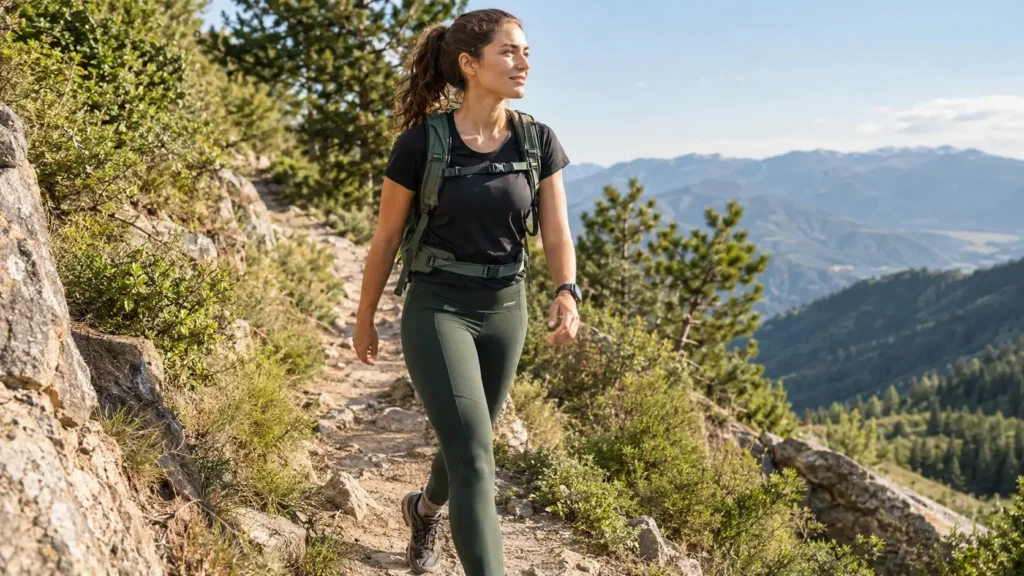

Let me give you the honest version of this answer rather than the one designed to make you feel good about a hobby you’d already enjoy anyway.
Hiking burns a meaningful number of calories — more than walking, less than running. The exact number depends on your body weight, the terrain, how long you hike, and whether you’re carrying a pack. For most beginner women doing day hikes on moderate trails, you’re looking at somewhere between 300 and 500 calories per hour. Over a three-hour hike, that’s 900–1,500 calories — which is genuinely significant.
Does that mean hiking will help you lose weight? Possibly — but with some important caveats that most fitness content conveniently skips.
How many calories does hiking burn?
The most accurate way to estimate calories burned hiking uses something called MET — Metabolic Equivalent of Task — which measures how hard your body is working relative to rest. Hiking MET values range from about 5.3 on flat easy terrain to 9.0 on steep technical climbs, compared to 3.5–5.0 for flat walking. That’s why hiking burns noticeably more calories than a walk at the same pace.
Here’s a practical estimate table based on body weight and trail type:
| Body Weight | Easy Trail (flat) | Moderate Trail | Steep Terrain |
| 120 lbs (54 kg) | ~270 cal/hr | ~370 cal/hr | ~480 cal/hr |
| 140 lbs (64 kg) | ~315 cal/hr | ~430 cal/hr | ~560 cal/hr |
| 160 lbs (73 kg) | ~360 cal/hr | ~490 cal/hr | ~640 cal/hr |
| 180 lbs (82 kg) | ~405 cal/hr | ~550 cal/hr | ~720 cal/hr |
| 200 lbs (91 kg) | ~450 cal/hr | ~610 cal/hr | ~800 cal/hr |
These are estimates based on the MET formula and 2024 Compendium of Physical Activities values. Your actual burn will vary — fitness trackers and hiking apps use similar calculations but results differ slightly between tools.
What affects how many calories you burn hiking?
Your body weight
The biggest single factor. Heavier bodies do more work to move the same distance — the MET formula scales linearly with your weight. A 200-pound person burns roughly 65% more calories per hour than a 120-pound person on the same trail.
Trail difficulty and elevation

Steep terrain dramatically increases calorie burn. A 10% grade trail burns roughly 50% more calories per hour than a flat trail at the same pace. Elevation gain is the most underestimated variable in hiking calorie estimates — many apps ignore it entirely, which is why their numbers often feel too low after a tough climb.
Pack weight
Carrying a daypack adds to your calorie burn. Every extra kilogram you carry adds roughly 10% more energy expenditure. A typical 5kg daypack adds about 50 extra calories per hour — not enormous, but it compounds over a long day.
Pace and duration
A brisker pace burns more calories per hour but also tires you out faster. For more on pacing and building trail confidence as a beginner, see the beginner hiking tips for women. Duration matters more for total calorie burn — a steady 3-hour moderate hike burns more total calories than a fast 45-minute flat walk, even if the hourly rate differs.
Temperature
Hiking in cold weather burns slightly more calories as your body works to maintain core temperature. In very hot weather, you burn slightly fewer calories from movement but more energy overall on thermoregulation. The difference is small — don’t choose your trail based on temperature for calorie reasons.
How does hiking compare to other exercise?

To put the numbers in context:
- Flat walking at 3mph: roughly 200–280 calories per hour
- Hiking on moderate terrain: roughly 350–550 calories per hour
- Jogging at 5mph: roughly 400–600 calories per hour
- Running at 7mph: roughly 550–800 calories per hour
Hiking sits between walking and jogging in terms of calorie burn — which is impressive given that it’s significantly lower impact than running and far more enjoyable for most beginners. It’s one of the best calorie-to-enjoyment ratios in outdoor exercise.
Does hiking actually help with weight loss?
Here’s the honest answer: it can, but it’s not magic, and it works the same way any exercise does.
Weight loss happens when you burn more calories than you consume over time. A 3-hour moderate hike burning 1,200 calories is meaningful — that’s roughly half a pound of fat in pure energy terms. But two things complicate the picture:
- Post-hike hunger is real. A long hard hike makes you hungry, and most people eat back a significant portion of the calories they burned. This isn’t a reason not to hike — it’s just reality.
- Consistency matters more than intensity. A 2-hour hike once a month won’t change much. Regular hiking — two or three times a week — combined with normal eating makes a real difference over months, not weeks.
The best argument for hiking as a weight loss tool isn’t the raw calorie number. It’s that most people actually enjoy hiking, which means they do it more consistently than gym workouts they dread. Consistency is the thing that drives results — and hiking makes consistency easier for many people.
What hiking does beyond calories

Focusing only on calories misses a lot of what hiking actually does for your body:
- Builds lower body strength — quads, glutes, calves and hip flexors all work hard on trail, especially on climbs and descents
- Improves cardiovascular fitness — regular hiking builds aerobic endurance in the same way jogging does, just more gradually
- Strengthens stabilizer muscles — uneven terrain engages small muscles in your ankles, knees and hips that flat gym cardio completely misses
- Mental health benefits — multiple studies confirm that time in nature reduces cortisol (the stress hormone), which itself contributes to weight management
- Low joint impact — hiking is significantly easier on your knees and hips than running, making it sustainable long-term for people who can’t run
How to burn more calories hiking
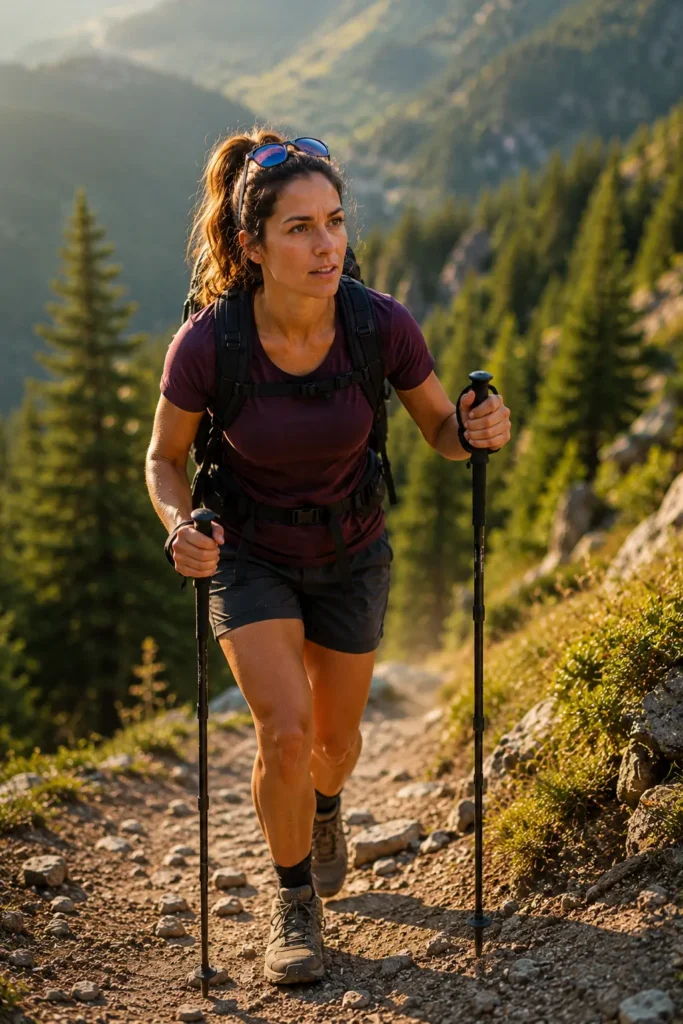
If you want to increase your calorie burn without dramatically changing your hike, here are the most effective levers:
- Choose trails with more elevation gain — it’s the single biggest factor after body weight
- Pick up your pace on flat sections when terrain allows
- Add trekking poles — they engage your upper body and can increase calorie burn by 10–15%
- Carry a slightly heavier pack — within reason, an extra couple of kilograms adds meaningful calorie burn over a long hike
- Hike longer — duration compounds. Adding an extra hour to a moderate hike adds 400–500 more calories burned
What to eat on a hike to support your goals
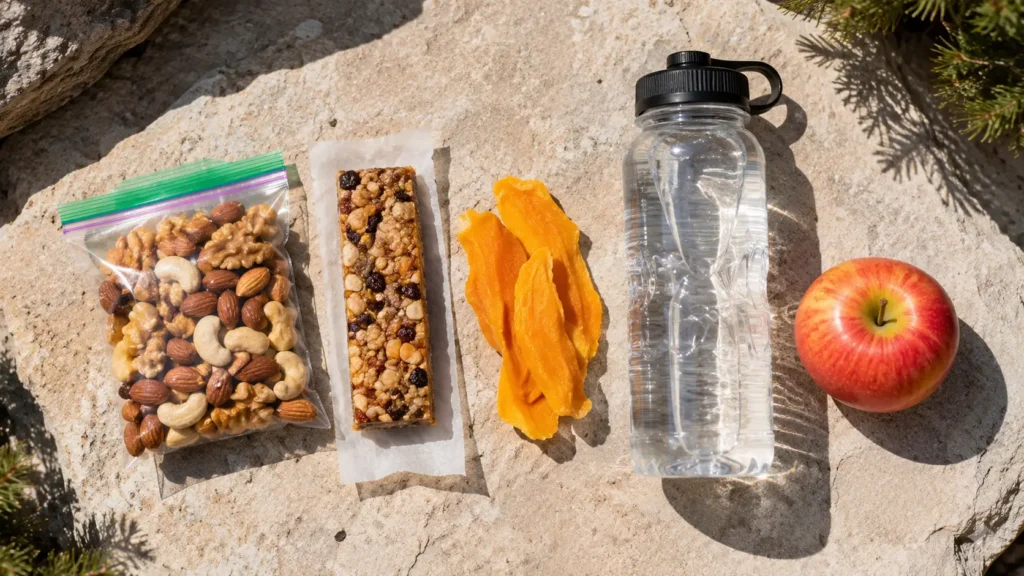
If you’re hiking for weight loss or fitness, the eating strategy matters as much as the hiking itself.
- For hikes under 2 hours: you probably don’t need to eat mid-hike — water is enough
- For hikes 2–4 hours: bring 200–300 calories of real food — nuts, an energy bar, fruit
- For hikes over 4 hours: aim for 200–300 calories per hour of hiking to avoid energy crashes, especially on steep terrain
Don’t severely restrict food on hikes thinking it will accelerate weight loss. For a complete list of what to pack for a day hike including food, the day hiking packing list for women covers every item. Bonking — running out of energy mid-trail — makes the hike miserable and can be dangerous on technical terrain. Fuel the hike properly and manage the calorie deficit through your overall diet, not by starving yourself on the trail.
Final thoughts
Hiking burns a real and meaningful number of calories — more than most people expect, especially on hilly terrain. For a beginner woman doing regular day hikes on moderate trails, the calorie burn is genuinely significant and the health benefits beyond calories are substantial.
Whether it helps with weight loss depends on how often you hike, how hard you push, and what you eat afterward. It’s not a magic fix, but it’s one of the most sustainable forms of exercise most people can build into their lives — and that consistency is worth more than any single session’s calorie count.
Hike because you enjoy it. The fitness will follow. If you’re just getting started, the day hiking essentials guide is the best place to begin.
FAQs
Most beginner women burn between 300 and 550 calories per hour hiking, depending on body weight and trail difficulty. A 140-pound woman on a moderate trail burns roughly 430 calories per hour. Steep terrain and elevation gain increase this significantly.
Yes, hiking can support weight loss — it burns significantly more calories than walking and is sustainable long-term because most people enjoy it. The key is consistency. Regular hiking two or three times a week, combined with normal eating habits, produces real results over months rather than weeks.
A 3-hour moderate hike typically burns between 900 and 1,650 calories depending on your weight and terrain. A 140-pound woman on a moderate trail burns roughly 1,290 calories over 3 hours. Steep elevation adds significantly to this total.
Yes — hiking burns roughly 50–100% more calories per hour than flat walking at a similar pace, primarily because trails involve elevation gain, uneven terrain, and often a heavier load. A moderate trail with elevation gain is genuinely more demanding than brisk flat walking.
The most effective ways to increase calorie burn are: choosing trails with more elevation gain, hiking at a brisker pace on flat sections, adding trekking poles (which engage the upper body), and simply hiking longer. Pack weight also contributes, though shouldn’t be increased beyond what’s comfortable and safe.

Intermediate hiker sharing real trail experience — honest gear picks, beginner-friendly guides, no filler.